Meaningful Short Bedtime Stories for Adults To Read
Discover short bedtime stories for adults that are calming, meaningful, and easy to read. Perfect for relaxing your mind

Looking for short bedtime stories for adults to help you relax and unwind before sleep? This collection features calming, meaningful, and easy-to-read stories designed specifically for adults.
Whether you’re searching for bedtime stories for adults to read, relaxing bedtime stories for adults, or short moral tales to reflect on, these stories are crafted to help you slow down your thoughts and ease into rest.
Each story is short, soothing, and ideal for nighttime reading-perfect if you want a gentle mental escape or a peaceful way to end your day.
→ Read our full story collection for adults here
Story 1 - The Brothers and the 80th Floor

There were two brothers who lived on the 80th floor of a tall building.
One day, after returning from a long trip, they discovered that the building had a power outage. The elevators were not working.
Carrying heavy bags, they had no choice but to climb the stairs.
The older brother said, “Let’s just climb up. We don’t have another option.”
So they began their long journey upward.
By the time they reached the 20th floor, both of them were exhausted.
The older brother suggested, “These bags are too heavy. Let’s leave them here and come back for them when the power is restored.”
The younger brother agreed.
They left their luggage on the 20th floor and continued climbing, now feeling much lighter and more relaxed.
They laughed and talked as they climbed higher.
But when they reached the 40th floor, fatigue set in again.
Realizing they were only halfway there, they began to complain.
They blamed each other for not checking the power outage notice earlier.
Arguments grew louder as they climbed.
Step by step, filled with frustration and regret, they made their way to the 60th floor.
At the 60th floor, they were too tired even to argue.
The younger brother said softly, “Let’s stop arguing and just finish this.”
From that point on, they climbed in silence.
Slowly, quietly, they reached the 80th floor.
Excited and relieved, they arrived at their door.
But then they realized something shocking.
Their keys were in the bags they had left on the 20th floor.
Moral of the story
Do not leave your dreams behind while chasing life.
From this story, we learn:
- Life is a journey with different stages
- Complaining wastes time and energy
- Dreams should never be forgotten
- What we leave behind may matter most in the end
What This Teaches
This is one of those short stories with moral lessons and stories with meaning that reflects our life journey.
Some say:
Before the age of 20, we live under the expectations of family and society. We carry pressure, responsibilities, and confusion.
After 20, we feel free. We drop some burdens and begin to chase our dreams with excitement and hope.
By 40, reality sets in. We begin to regret, complain, and compare. We wonder about the choices we made.
By 60, we finally understand. We stop complaining and try to live peacefully, making the most of what remains.
But at the end of life, many people realize something painful.
They left their dreams behind, somewhere in their youth.
Story 2 - The Power of Framing

My husband and I once found a house we really loved in the city. The price was 250,000 dollar. After checking our savings, we realized we only had 100,000 dollar, leaving a gap of 150,000 dollar.
We didn’t want to take a bank loan, so after discussing it together, we decided to ask relatives and friends for help. We split up and went separately, hoping to borrow enough money.
I started by visiting one of my cousins, but I was turned down. Then I went to several other relatives and friends. One after another, I explained our situation, hoping they would help.
By the end of the day, I had only managed to borrow less than 20,000 dollar.
I felt exhausted, embarrassed, and completely discouraged.
Lying on the sofa, I thought to myself:
“At this rate, how long will it take to collect 150,000 dollar? I’ve already asked almost everyone I know. There’s no hope left.”
Just then, my husband came home. He looked excited and was carrying a bag.
He drank some water quickly and poured the contents of the bag onto the table.
I was shocked.
It was a large pile of cash.
He smiled and said, “Guess how much? 80,000 dollar!”
I couldn’t believe it. I asked, “How did you manage to borrow so much? I spent the whole day and didn’t even get 20,000!”
My husband asked me how I had asked for money.
I replied, “I told everyone the truth. I said the house costs 250,000 dollar, and we are still short 150,000 dollar. I asked them to help us.”
He laughed and said:
“That’s exactly the problem.”
“When you say we need 150,000 dollar, people think we will be in heavy debt. With our income, it might take years to repay. That makes them worried.”
“Instead, I told everyone that we only needed 10,000 dollar more to complete the purchase.”
He continued:
“Repaying 10,000 dollar sounds easy and manageable. So people were much more willing to help.”
This short story with moral lessons shows how the same situation can lead to completely different outcomes depending on how it is presented.
Nothing changed about the actual problem. The only difference was the way it was explained.
This is one of those stories with meaning and life lessons that teaches us the importance of perspective.
Moral of the story
How you present a problem can change how people respond to it.
From this story, we learn:
- Perspective influences decisions
- Communication matters more than we think
- Small changes in wording can create big results
- Understanding others’ thinking leads to better outcomes
What This Teaches
In real life, success is not only about effort, but also about how we communicate.
This is why stories that teach a lesson like this are so valuable.
Whether in work, relationships, or daily life:
- People respond based on perception
- Fear and risk affect decisions
- Clear and positive framing builds trust
This is one of those character stories and short stories with a lesson that reveals a deeper truth:
Sometimes, the way you say something is just as important as what you say.
And mastering that skill can open many doors in life.
Story 3 - The Bottle by the Pump
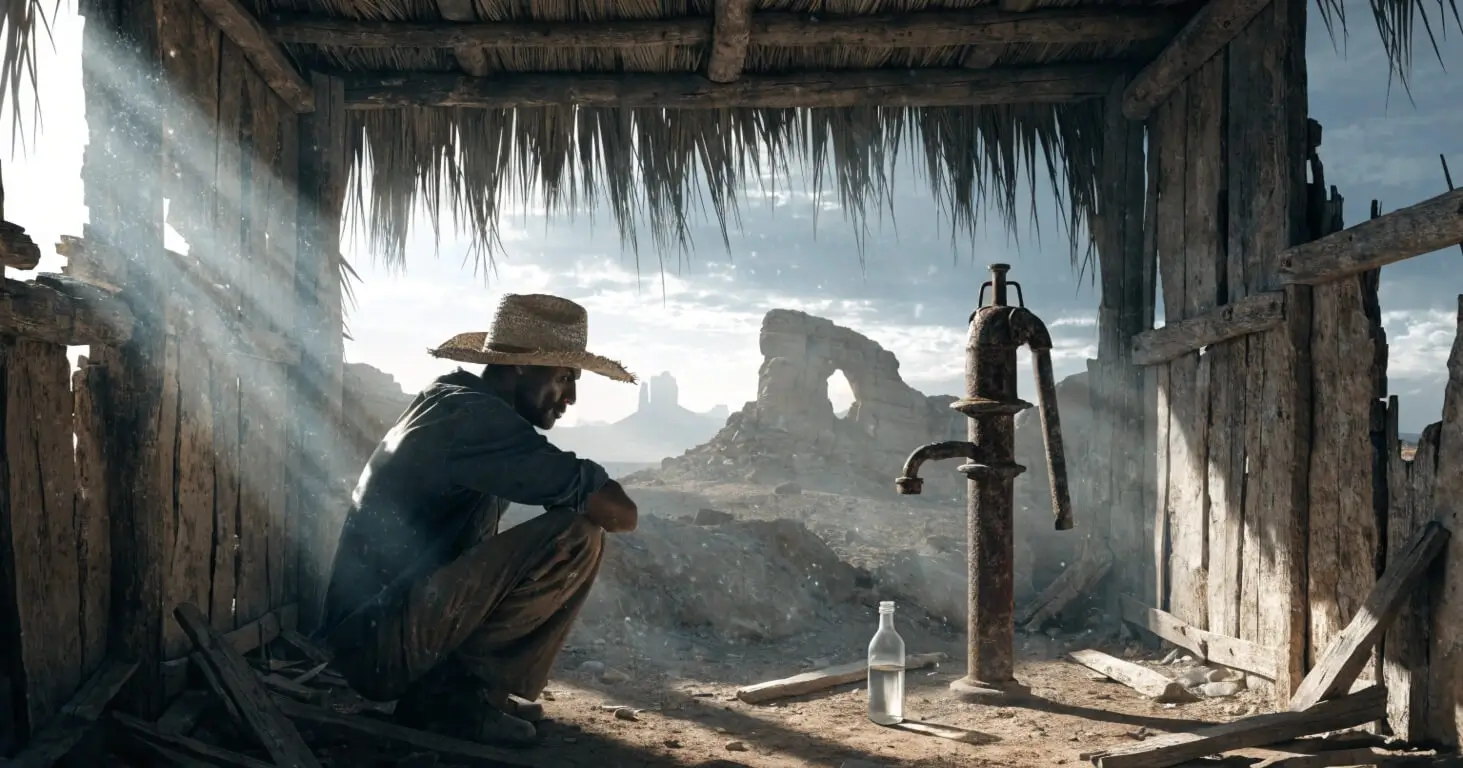
A man had been walking through the desert for two days.
Along the way, he encountered a violent sandstorm. After the storm passed, he completely lost his sense of direction.
Exhausted and nearly dying of thirst, he suddenly discovered an abandoned house.
Dragging his tired body inside, he found a small, poorly ventilated room filled with rotten wood.
In the corner of the room, he noticed something unexpected - a water pump.
Excitedly, he rushed forward and tried pumping water.
But no matter how hard he tried, not a single drop came out.
Disappointed, he sat on the ground.
Then he noticed a small bottle sealed with a cork beside the pump. Attached to it was a yellowed note.
The note read:
“You must pour this water into the pump to prime it before it will work.
Don’t forget to refill the bottle before you leave.”
He opened the bottle and found that it was indeed full of water.
Immediately, a fierce internal struggle began.
If he drank the water himself, he could survive long enough to leave the house.
But if he followed the instructions and poured the water into the pump, there was a risk that the water might never come back, and he could die of thirst.
Should he take the risk?
After a long moment of hesitation, he made a choice.
He poured every drop of water into the old pump.
With trembling hands, he began pumping.
Suddenly…
Water gushed out in great quantities.
Relieved, he drank as much water as he needed.
Before leaving, he refilled the bottle, sealed it with the cork, and added his own message to the note:
“Trust me, it works.”
Moral of the story
Sometimes in life, we must give before we receive.
Trust, generosity, and courage often open the door to greater rewards than playing it safe.
What This Teaches
In modern life, people often struggle between playing it safe and taking risks for greater rewards.
This story reflects a universal challenge: whether we trust the process and invest first, or choose immediate security.
In business, relationships, and personal growth, the principle often remains the same - those who are willing to give first are more likely to receive greater returns later.
It reminds us that trust, courage, and generosity are still powerful forces in today’s uncertain world.
Story 4 - The Scale

Long ago, two rice shops operated on the same street.
One was called A, and the other was called B.
During difficult times of war and instability, business became harder.
The owner of B decided to secretly gain an advantage.
He invited a scale maker and asked him to adjust the scale so that 15.5 ounces would be counted as one pound, allowing him to secretly earn extra profit.
The scale maker agreed in exchange for extra payment.
The shop owner’s youngest son had recently married the daughter of a teacher.
While sewing in her room, the new daughter-in-law overheard the conversation about cheating customers.
After thinking for a moment, she approached the scale maker and said:
“My father-in-law must have misspoken. Please make the scale 16.5 ounces equal one pound, and I will pay you even more. But please don’t tell him.”
The scale maker agreed.
Soon after the new scale was used, the B rice shop began attracting more customers.
Even loyal customers from the competing shop started coming.
Eventually, the other rice shop lost its business entirely and had to close.
B shop became very successful.
On New Year’s Eve, the family gathered for dinner.
The owner proudly asked everyone to guess the secret of their success.
After many guesses, he laughed and said:
“We became rich because of our scale.”
He proudly explained how the scale allowed him to secretly gain extra profit.
At that moment, the young daughter-in-law stood up and revealed the truth.
She had actually asked the scale maker to make the scale generous instead of dishonest.
Each pound of rice was slightly more than expected.
Because customers trusted the shop’s honesty, more and more people chose to buy there.
Although they earned slightly less per sale, they sold much more overall.
Their success came from integrity and trust.
Moral of the story
Short term gain from dishonesty may seem tempting, but long term success is built on trust and integrity.
Honest actions create lasting relationships and sustainable success.
What This Teaches
In today’s competitive business world, trust remains one of the most valuable assets a company can have.
Customers are more likely to support businesses that demonstrate honesty, fairness, and transparency.
This story reminds us that ethical behavior not only builds reputation but also creates long term prosperity.
Integrity may seem costly at first, but it often becomes the foundation of enduring success.
Story 5 - The Clever Bookseller

A publisher was struggling with a serious problem.
His warehouse was filled with books that no one wanted to buy. The unsold inventory kept piling up, and he was deeply worried.
One day, he came up with an unusual idea.
He asked a friend to deliver a beautifully bound sample copy of the book to the president.
After reading it, the president politely said:
“This is a good book.”
When the publisher heard this, he immediately used the president’s words in his advertisements.
Within less than two weeks, all the previously unsold books were completely sold out.
Some time later, another batch of books became difficult to sell.
The publisher tried the same strategy again and sent another book to the president.
This time the president responded honestly:
“This book is terrible.”
Instead of being discouraged, the publisher quickly launched a new advertisement:
“A book that the president calls terrible is now on sale!”
Once again, within two weeks, every copy was sold.
A few months later, the publisher faced the same problem again.
He sent another book to the president.
This time the president was cautious and chose not to comment at all.
When the publisher learned that the president had said nothing, he advertised:
“A book that even the president cannot evaluate!”
Curiosity spread quickly.
People wanted to know what kind of book even the president could not judge.
Within a few days, the books were sold out again.
Moral of the story
Creative thinking can turn problems into opportunities.
Success often depends not on circumstances, but on how we choose to respond to them.
What This Teaches
In today’s fast changing world, businesses and individuals constantly face challenges, criticism, and uncertainty.
This story highlights the power of creativity, adaptability, and strategic thinking.
Successful people are not those who avoid problems, but those who find innovative ways to transform obstacles into opportunities.
The ability to see possibilities where others see failure remains one of the most valuable skills in modern life.
Story 6 - Buddha, Why Didn’t You Help Me?

On a mountain called Nanshan stood a temple with a statue of Buddha.
People believed that this Buddha was extremely powerful and that sincere prayers would always be answered.
A man decided to test this belief.
To show his devotion, he carried offerings of chicken, pork, and fish up the mountain on Buddha’s birthday.
Despite exhaustion, he refused to stop or rest because he feared it might show disrespect.
After great effort, he finally reached the temple and prayed sincerely, asking Buddha to help him pass the imperial examination.
As he left the temple, a beggar approached him.
The beggar said he had not eaten for three days and begged for a little food from the offerings.
The man refused and drove him away, worried that the beggar would dirty the food.
That night, the hungry beggar froze and starved near the temple.
A sick dog had tried to share warmth with him, but the beggar also rejected the dog.
Both eventually died from cold and hunger.
Six months later, the man failed the exam again.
Angry, he returned to the temple and demanded to know why Buddha had not helped him.
Buddha asked him a simple question:
“Why should I help you?”
Buddha then summoned the spirits of the beggar and the dog.
They explained how both had asked for small kindness but were rejected.
Buddha said:
“Helping you succeed would have been easy for me.
But you refused to help others when it was within your power.
Why should I do for you what you were unwilling to do for others?”
With that, Buddha threw away the man’s examination destiny.
Moral of the story
If we refuse to help others when we have the ability, we cannot expect others to help us when we need it.
Kindness and generosity often return in ways we cannot see immediately.
What This Teaches
In modern society, many people focus primarily on personal gain and success.
However, communities thrive on empathy, cooperation, and generosity.
This story reminds us that compassion toward others is not only morally valuable but also essential for building meaningful relationships and a supportive society.
How to Use These Bedtime Stories (For Better Sleep)
Reading short bedtime stories can help calm your mind and reduce stress before sleep. Choose one story each night, read slowly, and avoid distractions.
You can also revisit your favorite stories to build a relaxing bedtime habit. These bedtime stories for adults to fall asleep work best when paired with a quiet environment and consistent sleep routine.
Discussion & Reflection Questions
- What part of the story resonated with you the most?
- Did the story remind you of a real-life situation?
- What lesson can you apply to your own life?
- How did the story make you feel before sleep?
- Would you read something similar again tomorrow night?
More Stories You May Like
→ Long Bedtime Stories for Adults to Fall Asleep
→ Discover our full collection of bedtime stories for adults
→ Want something more uplifting before sleep