Heartwarming & Cute Bedtime Stories for Adults
Read cute bedtime stories for adults that are soft, cozy, and heartwarming. Gentle stories to help you relax, feel comforted, and fall asleep peacefully.

Looking for cute bedtime stories for adults to gently end your day? This collection is filled with soft, heartwarming, and comforting stories designed to help you relax and feel at ease before sleep.
These stories focus on small moments, kindness, warmth, and quiet joy-perfect for creating a peaceful nighttime routine.
If you’d like to explore more, you can → explore our complete bedtime story collection
Story 1 - Life Is a Wonderful Show
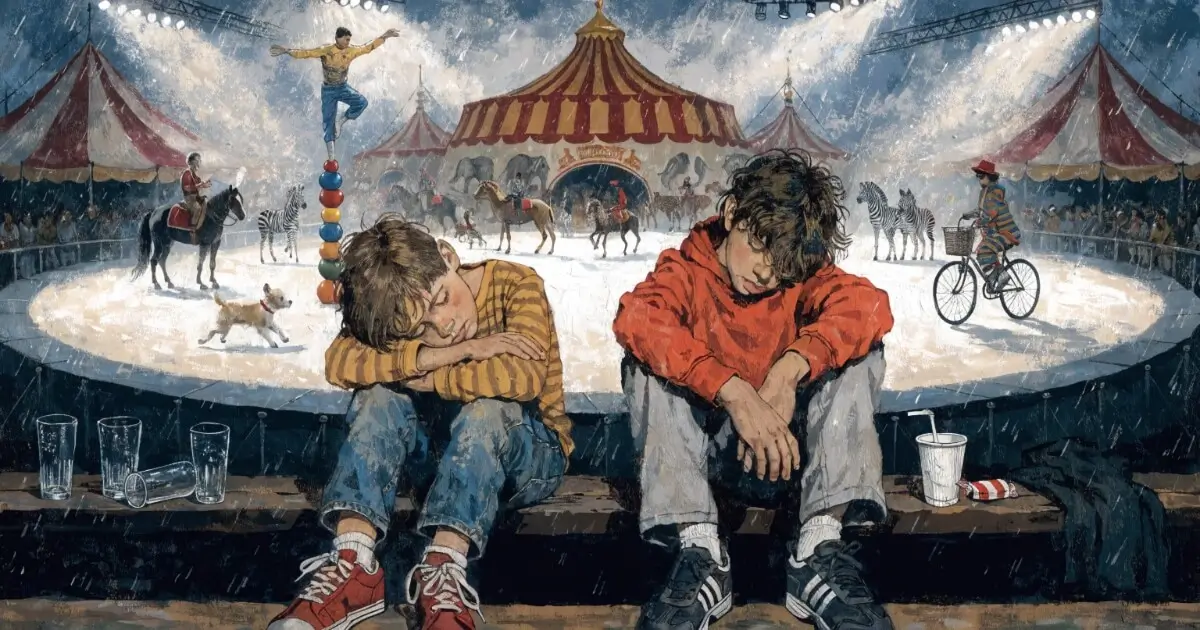
In a novel by an author whose name has since been forgotten, there is a story about a circus that arrived in a small town.
Because the circus needed many helping hands, they hired temporary workers from the town.
If someone worked three hours, they would receive a ticket to watch the show from the outer area.
If they worked six hours, they could enter the inner seating area.
But if someone worked an entire day, they would receive a ticket to sit in the very front row, right in the center.
Two poor brothers had spent their whole childhood dreaming of watching a real circus. They wanted to see the bears, the lions, the acrobats, and the clowns up close.
But a ticket cost more than their family could spare.
So they decided to earn one the only way they could.
They arrived before the sun was fully up.
All morning and all afternoon, they carried heavy equipment, hammered stakes into the ground, fetched buckets of water, swept dust from the tent floor, and hauled ropes across the field.
From the first light to the last.
By evening, every muscle in their bodies ached. Their hands were raw. Their feet were covered in blisters.
But they had earned what they came for.
They received the two best seats in the entire circus - front row, dead center.
That night, as the tent filled with noise and color and music, the two brothers took their places in the very first row.
Their clothes were stained with dust. Their palms throbbed.
When the host walked onto the stage and the crowd burst into applause, the two boys - exhausted beyond anything they had felt before - fell quietly asleep, right there in the best seats in the house.
The world is wonderful, much like a circus performance.
Each of us hopes to find a good seat and take in everything life has to offer.
From the moment we enter adulthood, voices around us urge us to push harder, climb higher, and move to the front row at all costs.
But it is worth pausing to ask ourselves a simple question.
Would you rather do your honest best and enjoy the show from wherever you sit?
Or would you rather exhaust everything you have - and fall asleep the moment the curtain rises?
Hard work and ambition are worth admiring.
But so is knowing where your limits are.
More often than we admit, the exhaustion we feel is not a sign of weakness - it is a sign that we have been trying to carry more than we were built to carry.
Pushing forward without that awareness does not lead to a better life. It leads to a life spent recovering from the last effort and dreading the next.
There are people who will cheer you on without ever considering whether the direction is right for you.
But no matter how determined a rabbit is, it cannot fly.
Encouragement without wisdom is just noise - and sometimes, it leads us further from the life we actually want.
Moral of the Story
Life is not only about reaching the best position.
True wisdom lies in knowing the difference between effort that builds you up and effort that quietly hollows you out.
We did not come into this world merely to struggle without end.
We came to watch the show - to notice the beauty, feel the wonder, and be present for the performance while it is still happening.
Remember: the goal was never just the seat. It was always the circus.
Why This Lesson Matters More Than Ever
Many people today move through life in a state of quiet exhaustion - chasing the next milestone, meeting the next expectation, pushing toward a finish line that keeps moving further away.
This story does not ask us to stop striving. It asks us to stop long enough to ask why.
Balance between ambition and rest is not a compromise. It is the only way to arrive at the front row still awake enough to enjoy what you worked so hard to see.
Work with purpose. But leave enough of yourself to actually live the life you are building.
Story 2 - What Do Women Really Want?

When King Arthur was young, he was captured on the battlefield by the forces of a neighboring queen.
She could have ordered his execution that same afternoon. Instead, she offered him something far more unsettling - a chance.
Arthur would be released for one year. During that time, he had to find the answer to a single question.
If his answer satisfied her, he would go free.
If not, he would return of his own accord and face whatever awaited him.
If he refused the terms entirely, he would never leave his cell again.
The question was this:
What do women truly want?
Even the wisest men stumble over such a question. Arthur was young, and he knew it. But honor, to him, was worth as much as life. He had agreed, so he would see it through.
He returned to Camelot and began asking everyone he could reach.
Scholars. Priests. Magicians. His mother. His sisters. Women he passed on the road who had no reason to help him.
Every answer he received was different.
Some said women wanted wealth. Others said beauty. Others said love, or safety, or power, or peace.
None of it felt like the whole truth.
Then, at last, someone pointed him toward a witch who lived at the edge of the woods - unpredictable, feared, and said by some to know things no one else did.
On the final evening before his deadline, with no better option left, Arthur went to find her.
She seemed to have been expecting him.
She would give him the answer, she said. The true answer. The one that would save his life.
But her price was this: Sir Gawain must marry her.
Arthur looked at her - her twisted frame, her hollow eyes, the wildness in her face - and then thought of Gawain. His most loyal knight. His closest friend. The most admired man at the Round Table.
He refused.
He would not purchase his own survival with someone else’s misery. He turned to go, prepared to ride back and face the queen.
When Gawain heard what had happened, he said nothing for a long moment.
Then he rode to the witch himself.
He agreed to the marriage without hesitation.
In exchange, the witch gave Arthur his answer:
What women truly want is the power to govern their own lives.
Arthur brought this answer to the queen.
She sat with it in silence for a moment - and then nodded.
His life was spared.
Gawain, as promised, married the witch in a full ceremony at Camelot. Arthur stood beside him with a heavy heart. Around the hall, knights and guests shifted uncomfortably, unable to hide their revulsion.
Gawain did not flinch. He stood straight, introduced his bride with dignity, and treated her with the quiet warmth he would have offered anyone he loved.
That night, when they were finally alone, Gawain turned - and found a woman of extraordinary beauty standing where the witch had been.
She watched him carefully as she explained.
His kindness, she said, had broken part of the enchantment. But only part of it.
She would be beautiful for half of every day. For the other half, she would return to the form he had married.
The choice, she told him, was his.
Which would you prefer - that I be beautiful in the day, when the world sees us? Or beautiful at night, when we are alone?
Gawain was quiet for a moment.
Then he said:
“This is your life more than it is mine. The choice should be yours.”
The woman looked at him for a long moment.
Then she smiled - slowly, warmly, in a way that had nothing to do with appearance.
“You are the first man,” she said, “who has truly understood.”
And because he had given her what no one else ever had - the freedom to choose for herself - the enchantment broke completely.
She remained as she was. And she was happy.
Moral of the Story
What women truly want is not to be managed, guided, or decided for - but to be trusted with their own lives.
And what this story whispers beneath the surface is something older and simpler still: that real love does not try to solve the other person. It makes space for them to be themselves.
Why This Lesson Matters More Than Ever
Many relationships quietly fracture not from cruelty, but from the slow accumulation of small decisions made for someone rather than with them.
This old legend reminds us that respect is not a gesture. It is a willingness to step back - even when you think you know better - and trust the person beside you to choose their own way.
The strongest relationships are not built on devotion alone. They are built on the kind of freedom that says: this is your life, and I honor that.
Story 3 - The Power of Trust

There was once a young man who had worked harder than most just to land a job in sales.
He showed up every day with everything he had - his time, his energy, his willingness to learn.
For more than six months, he gave the job his full effort.
And for more than six months, nothing seemed to work.
While his colleagues hit their targets and collected quiet praise, he watched from the outside - failing on major projects, falling short of every metric, invisible in all the wrong ways.
The gap between where he was and where everyone else seemed to be grew harder to look at.
Day after day, he carried the weight of it. The frustration. The self-doubt. The slow, grinding suspicion that he had somehow ended up in the wrong life.
Eventually, the weight became too much.
He walked into the general manager’s office one afternoon and said, plainly and without drama:
“I think I may not be suitable for this job.”
He braced for a dismissal. Or at least a disappointed nod.
Instead, the manager looked at him calmly and said:
“Stay. Keep working. I will give you the time you need - until you succeed. And when that day comes, if you still want to leave, I won’t stop you.”
The young man had not expected that.
He left the office with something he hadn’t walked in with.
Not a promotion. Not a solution. Just the quiet, steadying weight of someone else’s belief.
At the very least, he told himself, I should accomplish something before I go.
Something shifted in him after that conversation - not dramatically, but deeply.
He stopped rushing. He stopped panicking. He started paying attention.
He went back through his failures and looked at them honestly, without flinching. He changed his approach. He asked better questions. He became, slowly and then more steadily, someone who could actually do the work he had been hired to do.
Growth rarely announces itself. It simply accumulates - until one day, you look back and can no longer recognize where you started.
A year passed.
The young man walked into the manager’s office again.
This time he stood differently. Spoke differently. The nervous, defeated person who had once offered to leave was barely recognizable in the man standing there now.
For seven consecutive months, he had ranked first in sales across the entire company.
He had become, quietly and without fanfare, one of the most valuable people on the team.
It was only then that it struck him - fully, and with some disbelief:
This job had always been right for him.
He had simply needed time to grow into it.
Curious, he asked the manager the question that had stayed with him:
“Why did you keep me? I was failing badly. Why didn’t you just let me go?”
The manager smiled.
“Because I was even more unwilling to give up than you were.”
He continued:
“When we were hiring, more than a hundred people applied. I interviewed over twenty of them personally. In the end, I chose you - only you. If I had accepted your resignation, it would have meant admitting I had made a mistake.”
“I believed that since you had earned my trust in that interview room, you had what it took to earn the trust of clients too. What you lacked wasn’t ability. It was time. And opportunity.”
He paused before adding:
“In a way, I wasn’t only believing in you. I was also believing in my own judgment.”
Moral of the Story
The young man who told this story later said: I am that young man.
And from everything he went through, he drew one conclusion that has stayed with him since:
When you offer someone genuine trust - and when you offer yourself the same - the outcome can be something neither of you could have predicted.
Ability without time is a seed without soil.
And sometimes, all a person needs is one voice that refuses to count them out.
Why This Lesson Matters More Than Ever
We live in a world that measures people quickly and moves on just as fast.
A bad quarter. A missed target. A rough stretch that looks, from the outside, like the whole story.
But this is rarely the whole story.
This is why the manager’s response matters so much - not because it was kind, though it was, but because it was patient in a way that changed what was possible.
In workplaces, in families, in the quieter corners of our own minds, the willingness to wait for someone - to give them time without conditions - is one of the rarest and most powerful things one person can offer another.
Failure is almost never the final word.
Sometimes it is simply the part of the story that comes just before the turn.
Story 4 - Kindness Is the Gold of Life

What is the most valuable thing in the world?
Victor Hugo, the French writer who understood human nature as well as anyone, gave a surprisingly simple answer: kindness.
He described it as a rare pearl - something that has always existed throughout history, but has never been common. And he believed that a person who is genuinely kind stands taller, in the ways that matter most, than one who is merely powerful or successful.
Across cultures and centuries, this instinct has held. Laws tell us what we must do. Kindness tells us who we are.
After a violent storm, thousands of fish were left stranded on a beach, gasping in the open air.
A young boy walked along the shore, picking them up one by one and returning them to the sea.
An old man watched for a while, then said what seemed obvious:
“There are thousands of fish here. You cannot possibly save them all. What you are doing changes nothing.”
The boy bent down, picked up another fish, and gently sent it back into the water.
Then he looked up and said:
“It changes something for this one.”
The old man had nothing left to say.
That small exchange has stayed with me because it reframes everything. We so often measure the worth of an action by its scale - how many people it reaches, how much it changes. But the boy understood something quieter and more true: that doing good for one person is not a lesser version of doing good for many. It is the same thing, only closer.
Deep in the jungles of Brazil, a hunter shot a leopard.
The animal did not die immediately. Instead, it dragged its wounded body through the undergrowth for nearly half an hour - not fleeing, not searching for safety, but moving with slow and deliberate purpose toward something.
Her cubs.
With whatever strength she had left, the mother fed her young one last time.
Then she lay down and did not rise again.
The hunter, who had seen many things in his life, stood watching with tears on his face.
He broke his gun.
What moved him was not pity exactly - it was recognition. In that animal’s final act, he saw something he could not look away from: the willingness to spend everything you have left on the ones you love. There is no word for that except devotion. And devotion, when we witness it, has a way of waking something in us that had gone quiet.
Mark Twain once wrote that kindness is a language that the blind can see and the deaf can hear.
It is easy to read that as a pleasant sentiment. But there is something precise in it.
Kindness does not require the right conditions. It does not need to be earned or explained. It moves through situations where nothing else can - across language, across distance, across the silence that opens up between people when words have run out.
People who carry genuine kindness with them change the atmosphere of wherever they are.
Not loudly. Not always visibly.
But steadily, in the way that warmth changes a room - you notice it most in its absence.
Moral of the Story
We tend to measure people by what they have accomplished - the positions they have reached, the things they have accumulated, the recognition they have received.
But none of that is what we remember about a person when they are gone.
What we remember is how they made us feel. Whether they saw us. Whether they were generous when they had no obligation to be.
Small acts of kindness are not a substitute for something larger. They are the larger thing, expressed in the only scale most of us ever actually operate on - one person, one moment, one choice at a time.
Why This Still Matters Today
The world tends to reward performance and punish slowness. It celebrates the bold and overlooks the gentle.
But beneath all of that, something in us still responds to kindness the way a plant responds to light - instinctively, gratefully, turning toward it without quite knowing why.
Because kindness is not soft. It takes something to remain open and generous in a world that frequently gives you reasons not to be.
It is, in that sense, one of the harder things.
And one of the most worth practicing.
Story 5 - The Witch and the Smiling Moon

The silly witch was walking home through the valley when the sky began to darken around her.
She came to a small river and stepped out onto a narrow wooden bridge.
Below her, the water moved in slow, quiet ripples. The night was still and clear.
She looked down - and there was the moon, lying in the river, shimmering on the surface of the moving water. It seemed to shift and breathe. It seemed, almost, to be smiling up at her.
The silly witch stood very still.
In the water jar in her yard, there was a moon too. But that moon just sat there in the stillness, flat and silent. It had never once smiled.
This moon was different.
I must take it home, she thought. If I can smile at it and it smiles back at me, that would be the most wonderful thing in the world.
She ran home, grabbed a wooden bucket, and hurried back to the bridge.
She lowered the bucket carefully into the water and lifted - but just as the moon rose toward the surface, the bottom of the bucket gave way with a soft crack, and the moon slipped back into the river.
The silly witch stamped her feet and ran home for another bucket.
This time the bottom held. But when she leaned too far over the railing, the bucket twisted from her hands and fell into the water with a heavy splash and was gone.
It was too late to try again that night.
The next evening, the moon was still there - still smiling its shimmering smile across the rippled water. She lowered a fresh bucket slowly, slowly, and lifted it with trembling hands.
Then a frog leapt from the bank and landed right in the center of the bucket. The water churned. The moon broke apart into a dozen scattered pieces and disappeared.
On the third night, there was no moon in the sky, and no moon in the water.
On the fourth night, the sky was clear - but the wind moved through in long, restless gusts. The river shook and shifted beneath her, and when she looked down, the moon was not smiling. Its reflection wavered and trembled, as though it were about to cry.
The silly witch almost cried too.
But on the fifth night, everything was calm. The bucket held. The water was steady. She scooped the moon up gently and carried it home without a single mishap.
She set the bucket down. Caught her breath. Leaned over to smile at the moon at last.
The water had gone still.
And the moon - the smiling moon she had worked five nights to bring home - had no expression at all.
The silly witch felt something inside her quietly give way.
She had tried everything she could think of. She had run back and forth, replaced bucket after bucket, waited out clouds and wind and frogs and bad luck. And still, she could not keep what she wanted.
She stopped trying for a while. She didn’t feel much like doing anything.
Then one evening she crossed the bridge again - and found another witch sitting quietly at the water’s edge. A calm witch, with her hands folded in her lap and a gentle smile on her face.
The calm witch looked up and waved, and patted the ground beside her in invitation.
The silly witch sat down.
And at the moment she settled and grew still - she saw it.
There, on the softly moving surface of the river, the moon was smiling.
Not at her bucket. Not at her efforts. Just smiling, the way it always had, at anyone willing to sit beside it long enough to look.
The calm witch had already been there for some time.
She had not brought a bucket. She had simply come, and sat, and smiled - and the moon had smiled back without hesitation.
That night, for the first time, the silly witch got exactly what she had always wanted.
Not by catching it. Not by carrying it home.
Simply by being there.
Later, she looked at the moon’s reflection and said quietly:
“If I had stopped trying to take you home much sooner, I might have sat here smiling with you a long time ago.”
The moon did not answer.
It simply went on smiling - the way it always had, the way it always would, for anyone still enough to notice.
Moral of the Story
Some things cannot be caught or kept.
They can only be met - in the right moment, with the right kind of stillness.
The moon in the river was never hiding from the silly witch. It was there every night, offering the same smile it always had. What she could not see, until she stopped reaching, was that the thing she wanted had never required her to do anything at all.
Why This Story Still Matters Today
We live in a way that rewards effort - and there is nothing wrong with that.
But some of the things we most want do not respond to effort. They respond to presence.
Joy, like the moon in the river, has a way of disappearing the moment we try to hold it still. And a way of returning, quietly and completely, the moment we sit down beside it and simply let it be.
The calm witch is not lazy. She is not passive.
She simply knows something the silly witch had to learn the hard way: that some happiness is not something you go out and get.
It is something you become quiet enough to receive.
Why Cute Bedtime Stories Matter
Soft and heartwarming stories can help reduce stress and create a sense of emotional comfort before sleep. These cute bedtime stories for adults are designed to bring a gentle smile and a calm mind as you end your day.
Reflection Questions
- What moment felt the most comforting?
- Did the story make you smile?
- What small joy did it remind you of?
- How do you feel now compared to before reading?
Explore More Bedtime Stories
- Discover the full collection → discover more relaxing nighttime reads
- Try shorter reads → try shorter stories for a quick relaxing read
- Prefer deeper narratives → enjoy longer stories for a slow evening
- Or looking for something more uplifting before sleep
- Unique adorable adult bedtime reads